Use mouse wheel, arrow keys or left click (with scroll tool selected) to scroll
Drag with one finger (with the scroll tool selected) to scroll
DICOM HelpSource: Local (us-east1-c)
Findings
- Atlanto-occipital dislocation with more extensive widening of the left atlanto-occipital joint relative to the right
- Widening of the C1-C2 articulation bilaterally
- Widening of the distance between the posterior arches of C1 and C2
- Upper cervical prevertebral edema
- No acute fracture
- Partially imaged endotracheal and enteric tubes
Diagnosis
Atlanto-occipital dislocation
Sample Report
Atlanto-occipital dislocation with atlanto-occipital intervals measuring 10 mm on the left and 6 mm on the right, concerning for extensive ligamentous injury.
Lesser degree of atlantoaxial dislocation/dissociation with atlantoaxial intervals measuring 5 mm on the left and 6 mm on the right.
Cervical spine MRI without contrast could further evaluate the extent of ligamentous injuries.
No acute fracture.
Upper cervical prevertebral edema.
Discussion
- Remember that kids, especially young kids, rarely fracture their cervical spines, so even in cases of horrific cervical trauma there is often no fracture
- Look closely for symmetry and measure intervals if there is any concern (it might be good to measure intervals in all young kids early on)
- If you see prevertebral edema, be very concerned that there is underlying ligamentous injury, and even if the intervals measure normal, at least suggest an MRI to further evaluate
Annotated Images & Illustrations
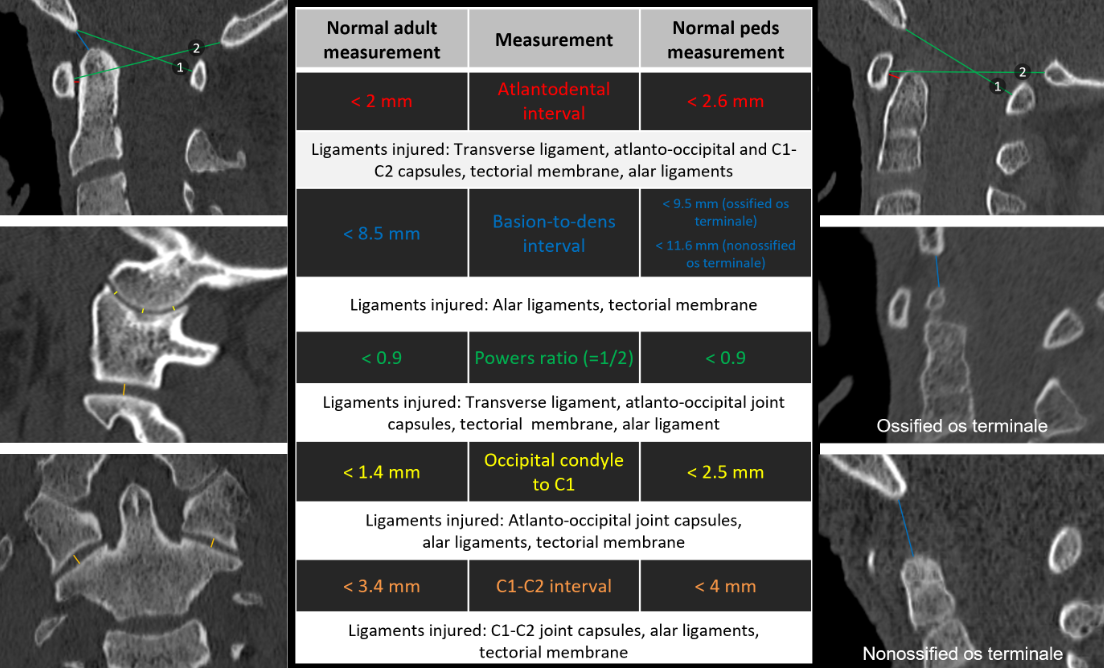
Diagram of helpful measurements to know.
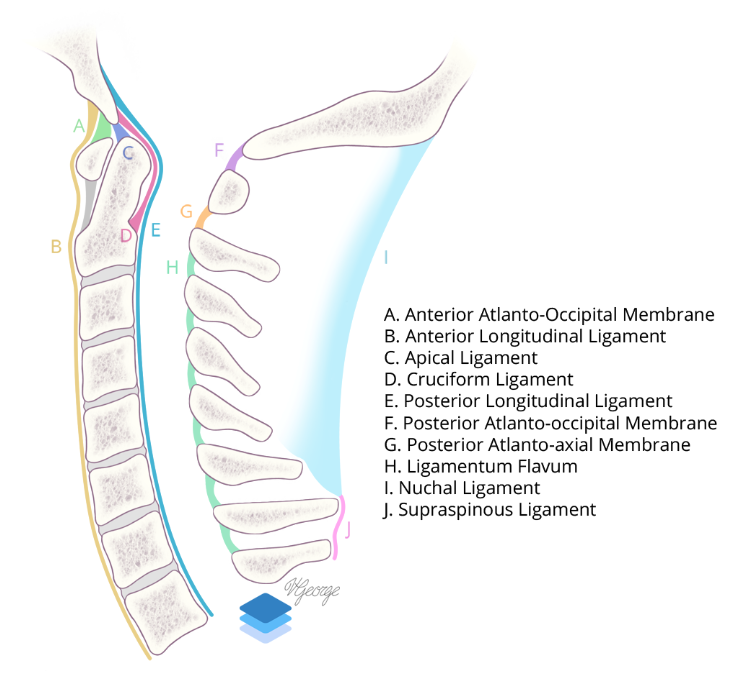
Sagittal view of the major cervical spine ligaments.
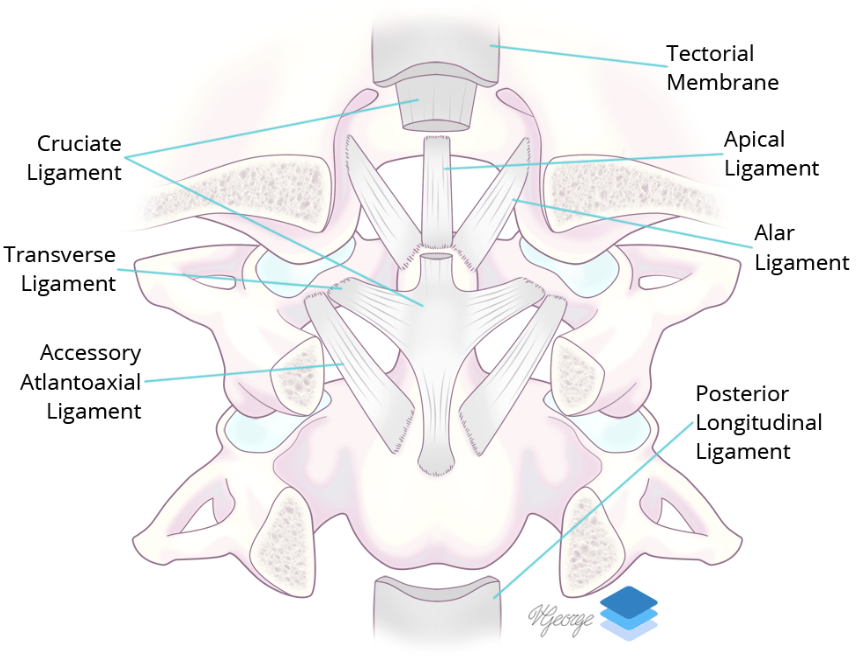
Coronal view of the major ligaments at the craniocervical junction.
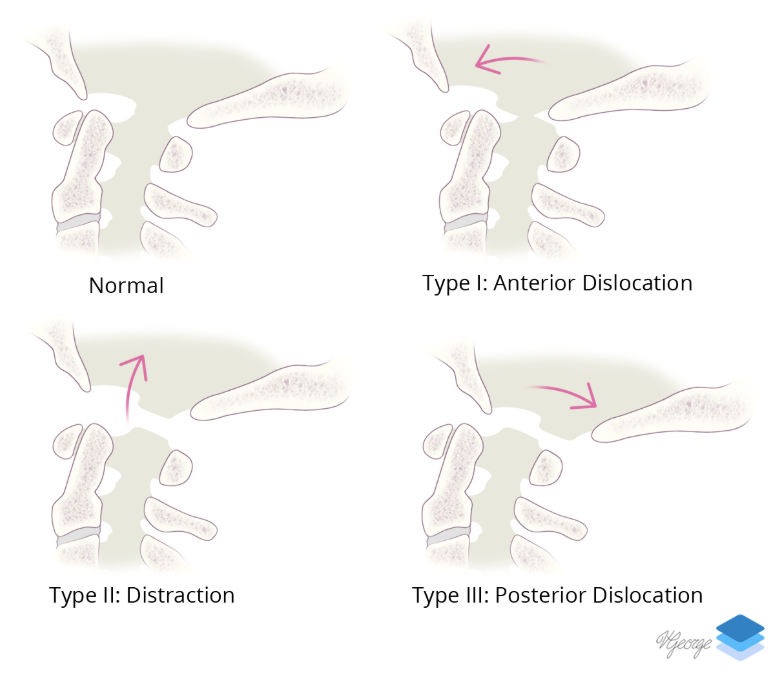
Types of craniocervical dislocation.
Related Video
Cervical Spine Trauma
YouTube
References