Use mouse wheel, arrow keys or left click (with scroll tool selected) to scroll
Drag with one finger (with the scroll tool selected) to scroll
DICOM HelpSource: Local (us-east1-c)
1/23
Demographics:
75 years old, Male
Indication:
Dementia
Findings
- Symmetric volume loss involving both temporal lobes and hippocampi with ex vacuo enlargement of the temporal horns of both lateral ventricles, which is out of proportion to the degree of generalized cerebral and cerebellar volume loss
- Patchy T2/FLAIR hyperintensity in the subcortical and periventricular white matter, which although nonspecific likely relates to chronic small vessel disease
- T2 hyperintense lesion extending from the posterior aspect of the right nasal cavity into the nasopharynx, likely a polyp
- Bilateral ethmoid air cell mucosal thickening
- Bilateral pseudophakia
- Anterolisthesis at C3-C4 results in mild spinal canal narrowing
Diagnosis
Alzheimer disease
Sample Report
Advanced bilateral temporal and hippocampal volume loss out of proportion to the over degree of cerebral atrophy, which can be seen with Alzheimer disease.
No acute intracranial abnormality.
Discussion
- Clinical
- Alzheimer disease is the most common cause of dementia in the elderly
- Progressive cognitive impairment (often beginning with memory loss followed by apraxia and loss of executive function) that gradually leads to loss of functional independence
- Patients may survive 10 years or more after diagnosis
- Histopathology/Genetics
- Accumulation of beta amyloid plaques in cortical gray matter and in arteriole walls
- Abnormal tau phosphorylation leads to development of neurofibrillary tangles (seen earliest in the entorhinal cortex)
- A minority of cases are familial arising in the setting of genetic mutations in several genes including the amyloid precursor protein (APP) gene
- Imaging Findings
- Atrophy (and corresponding hypometabolism on PET imaging) in the following areas:
- Mesial temporal lobes including the entorhinal cortex and hippocampus (especially CA-1) - look for disproportionate ex vacuo enlargement of the temporal horns
- Posterior cingulate gyri
- Parietal lobes (especially precuneus), sparing the primary cortex until late in the disease
- May see findings of amyloid angiopathy (multiple lobar microhemorrhages relatively sparing the deep gray structures)
- Amyloid-specific PET agents show abnormal cerebral gray matter radiotracer uptake
- Atrophy (and corresponding hypometabolism on PET imaging) in the following areas:
Annotated Images & Illustrations
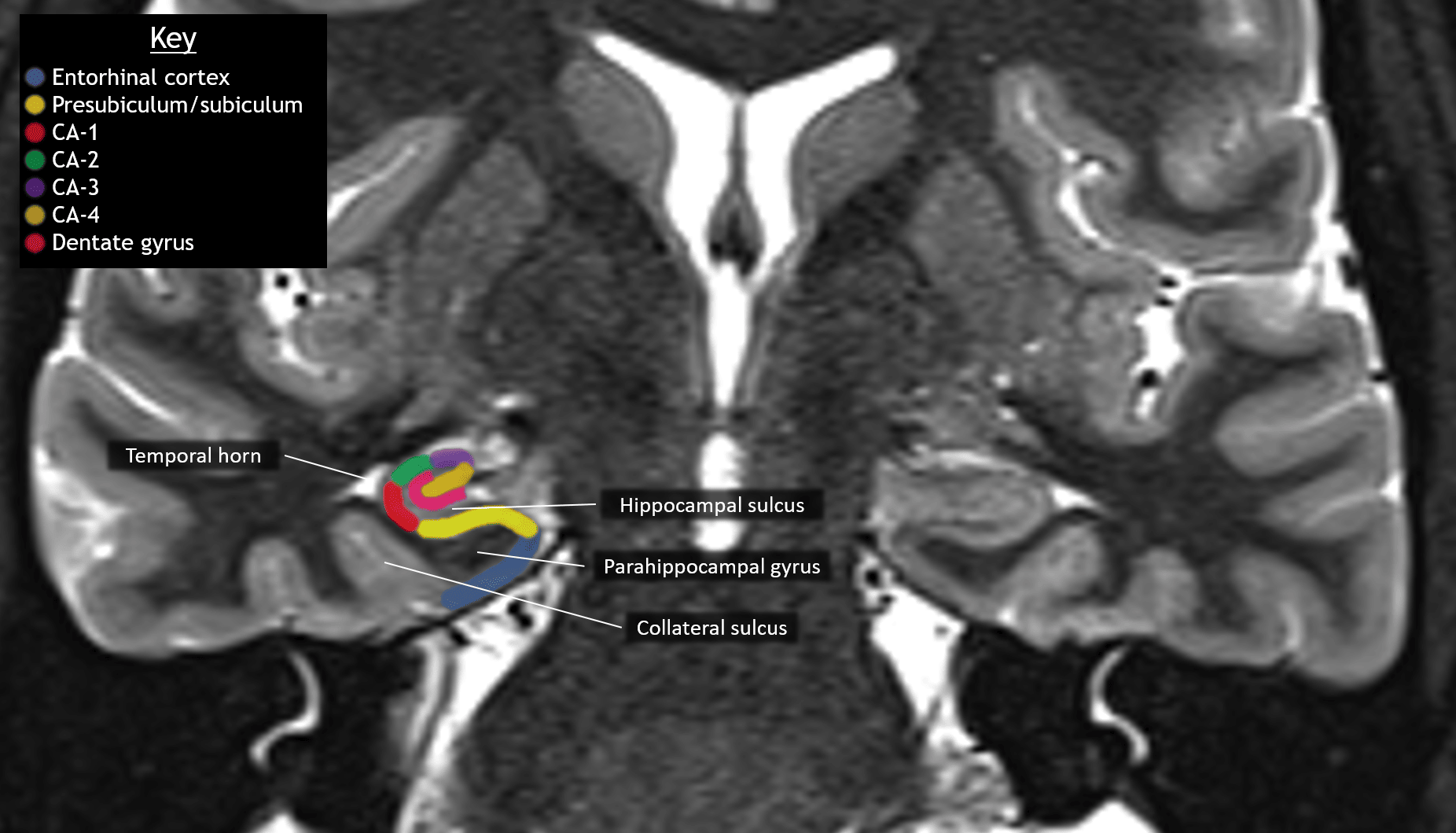
Anatomy of the mesial temporal structures on a coronal STIR image from a young, healthy patient.
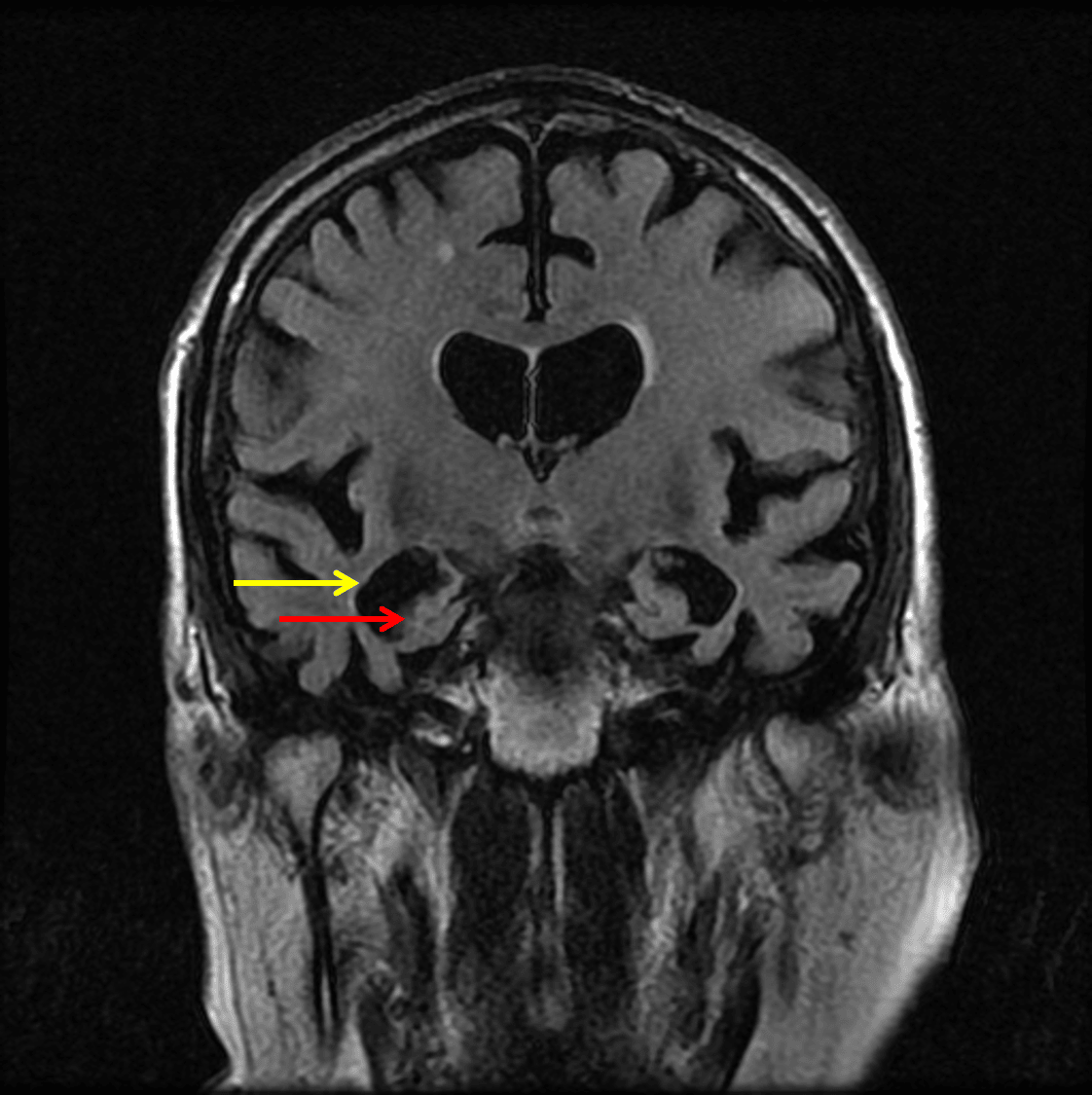
Disproportionate volume loss of the hippocampi and parahippocampal gyri (red arrow) with ex vacuo temporal horn enlargement (yellow arrow) in this patient with Alzheimer disease.