Use mouse wheel, arrow keys or left click (with scroll tool selected) to scroll
Drag with one finger (with the scroll tool selected) to scroll
DICOM HelpSource: Local (us-east1-c)
Findings
- Acute L1 vertebral body fracture with approximately 30% height loss and 6 mm bony retropulsion with resultant advanced spinal canal stenosis at this level
- Ventral epidural hematoma extending inferiorly from the L1 fracture to the level of the L4 superior endplate, measuring up to 5 mm in thickness with resultant advanced spinal canal stenosis at L1-L2, moderate spinal canal stenosis at L2-L3, and mild spinal canal stenosis at L3-L4
- Possible focal disruption of the anterior and posterior longitudinal ligaments at the level of L1
- T2/STIR signal hyperintensity in the T12-L1 interspinous ligament and in the supraspinous ligament at the level of T12 with focal disruption
- Prevertebral edema from L1-L2
- T1/T2/STIR hyperintense lesions in the T12 and L3 vertebral bodies, likely representing atypical vertebral venous malformations (hemangiomas)
- Disc dessication and height loss at L5-S1
- Facet hypertrophy and ligamentum flavum thickening contribute to mild bilateral neural foraminal stenosis at L4-L5 and L5-S1
- Conus terminates in normal position without signal abnormality
- Trace anterolisthesis at L4-L5
Diagnosis
Epidural hematoma
Ligamentous injury
Sample Report
Acute L1 vertebral body fracture with approximately 30% height loss and 6 mm bony retropulsion with resultant advanced spinal canal stenosis at this level. No abnormal signal of the conus.
Ventral epidural hematoma extending inferiorly from the L1 fracture to the level of the L4 superior endplate, measuring up to 5 mm in thickness with resultant advanced spinal canal stenosis at L1-L2, moderate spinal canal stenosis at L2-L3, and mild spinal canal stenosis at L3-L4.
Possible focal disruption of the anterior and posterior longitudinal ligaments at the level of L1.
Interspinous and supraspinous ligament injury at T12-L1 with focal disruption of the supraspinous ligament adjacent to the T12 spinous process.
Discussion
- Always be on the lookout for epidural hematomas in the setting of trauma, as these can sometimes result in more symptomatic cord and nerve root compression than the fractures themselves
- Expect to see ligamentous injury when you see a fracture involving more than one column
- In particular, make sure to assess the integrity of the posterior ligamentous complex (PLC), which consists of the following:
- Supraspinous ligament
- Interspinous ligaments
- Facet joint capsules
- Ligamentum flavum
Annotated Images & Illustrations
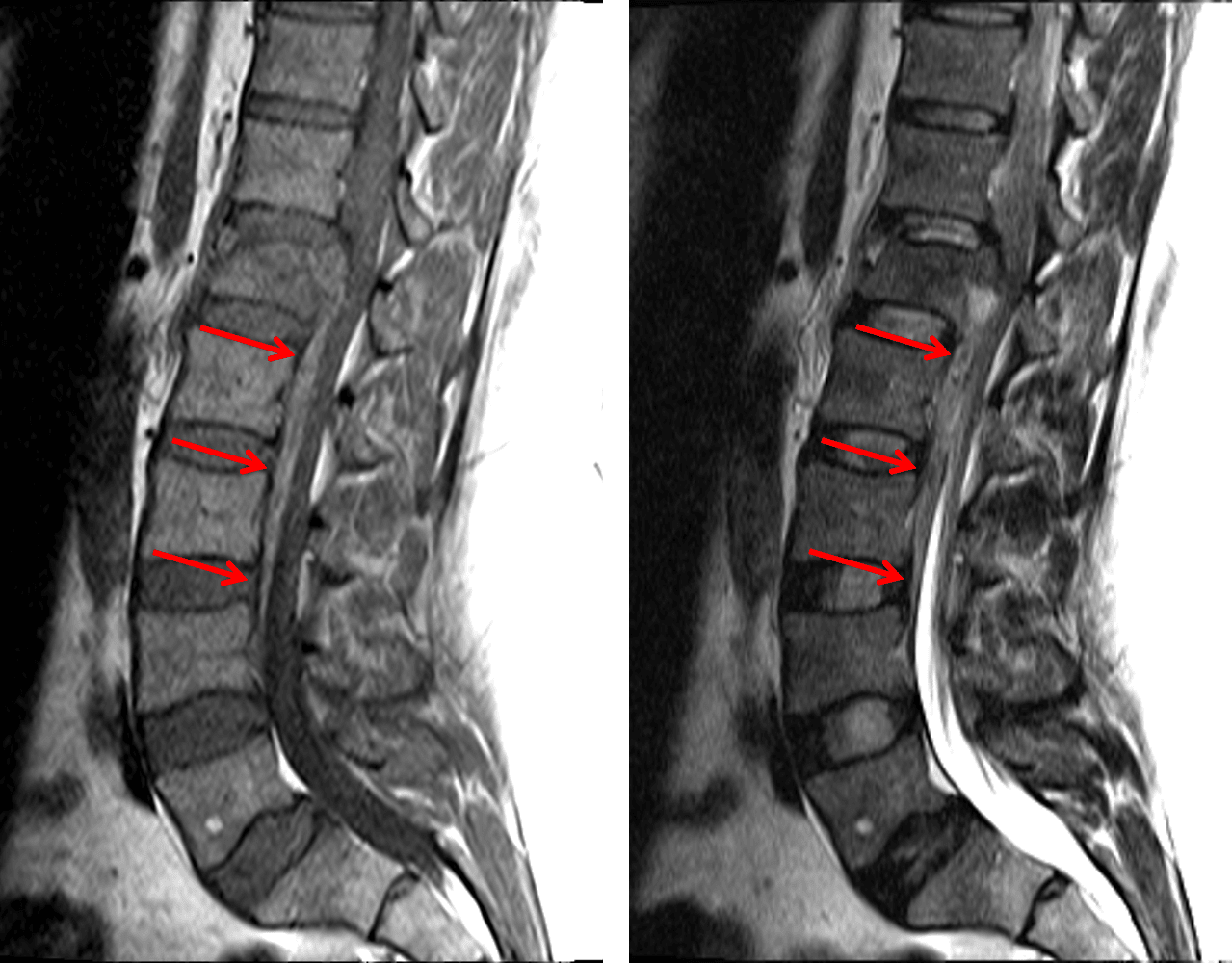
Ventral epidural collection (red arrows) that is hyperintense on T1-weighted images (left) and iso- to mildly hyperintense on T2-weighted images (right) consistent with an epidural hematoma.