Use mouse wheel, arrow keys or left click (with scroll tool selected) to scroll
Drag with one finger (with the scroll tool selected) to scroll
DICOM HelpSource: Local (us-east1-c)
Findings
- T2/STIR signal hyperintensity in the anterior and posterior atlantooccipital membranes and bilateral atlantooccipital joints with mild widening of both atlantooccipital joints
- Widening of the basion-dens interval with discontinuity of the apical ligament and mixed signal material about the odontoid process and in the supraodontoid space exerting mass effect on the upper cervical spinal cord at the level of C1
- No discontinuity of the tectorial membrane
- Abnormal T2/STIR signal hyperintensity extending from the caudal medulla through the cervical spinal cord to the level of C2-C3, most pronounced at the level of C1
- T2/STIR signal hyperintensity in the interspinous ligament at multiple levels, most pronounced at C5-C6
- T2/STIR signal hyperintensity in the nuchal ligament extending from the occiput inferiorly to the level of C6
- T2/STIR signal hyperintensity in the prevertebral soft tissues extending from the skull base through the level of C4-C5
- Large T1 isointense, T2 hyperintense epidural collection extending from the level of C2 inferiorly through the cervical and visualized upper thoracic spine. This collection is mainly located ventrally in the cervical spine and dorsally in the upper thoracic spine
- Partially imaged endotracheal and enteric tubes
- Right greater than left pleural effusions
Diagnosis
Atlantooccipital dissociation
Sample Report
Findings consistent with atlantooccipital dissociation with disruption of the apical ligament and concern for bilateral C1-C2 joint capsular injury. Mild associated widening of the basion-dens interval and bilateral C1-C2 articulations. The tectorial membrane appears intact.
Extensive ligamentous injury involving the anterior and posterior atlantooccipital membranes as well as the interspinous and nuchal ligaments at multiple levels.
Hemorrhage about the odontoid process with cord contusion at the level of C1. Surrounding edema extends from the caudal medulla to the level of C2-C3.
Large epidural hematoma extending from C2 through the upper thoracic spine, incompletely evaluated on this study, which results in mild multilevel narrowing of the spinal canal. Consider dedicated thoracic and lumbar spine MRI for a more complete assessment of this collection.
Extensive prevertebral edema/hematoma.
No findings to suggest an acute fracture.
Discussion
- The atlantooccipital joint is commonly injured in high impact trauma, particularly in children, and though serious often has only subtle associated findings on CT
- Make sure to assess the intervals shown in the annotated images below in trauma cases to avoid missing these injuries
- Many of the stabilizing ligaments can be identified and assessed on MRI, which are shown in the annotated images below
- The two most important ligaments for stabilizing the craniocervical junction are the alar ligaments (which extend obliquely from the dens to the occipital condyles) and the tectorial membrane (the superior continuation of the posterior longitudinal ligament)
Annotated Images & Illustrations
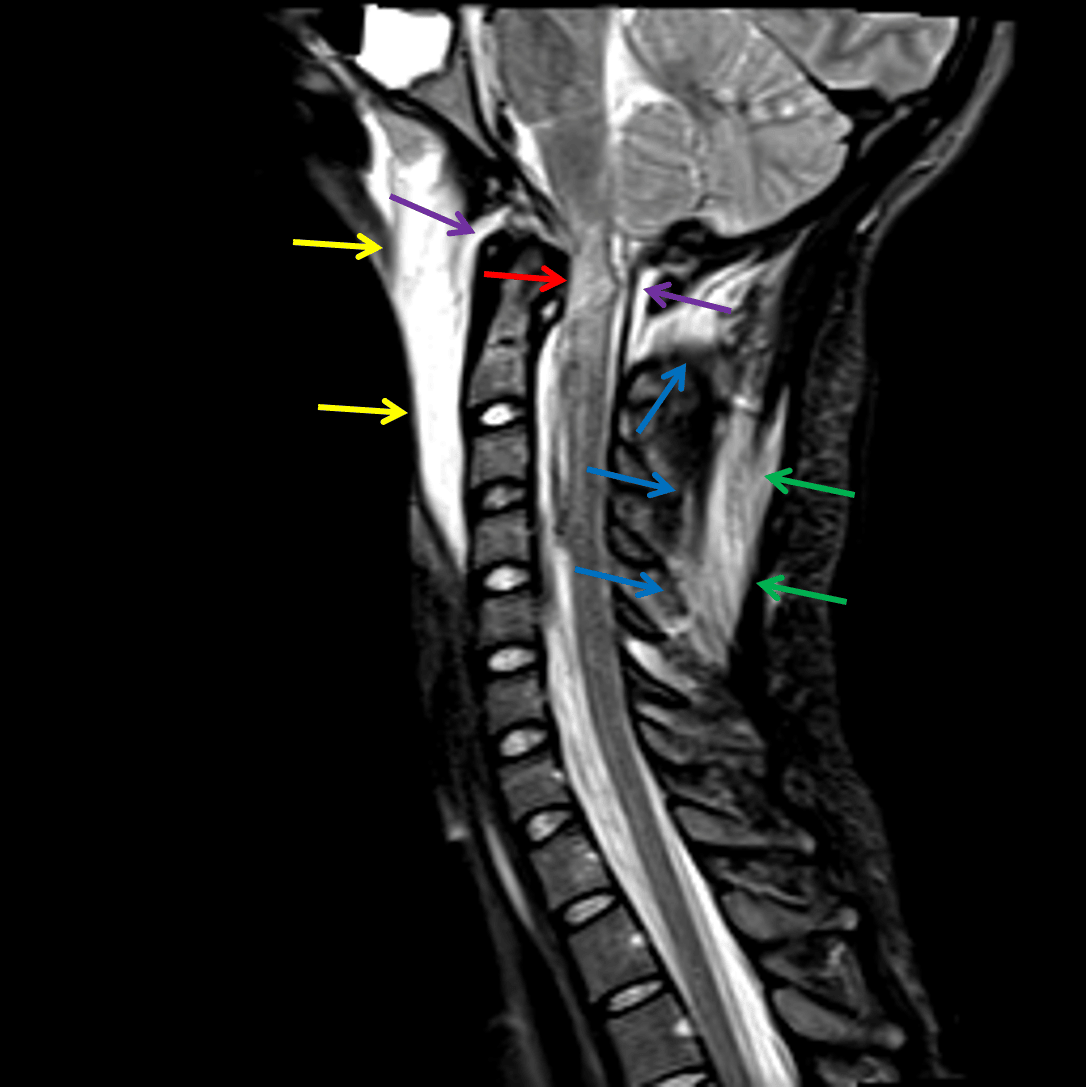
Yellow: prevertebral edema. Purple: edema in the anterior and posterior atlantooccipital membranes. Red: cord contusion. Blue: edema in the interspinous intervals. Green: edema along the nuchal ligament.
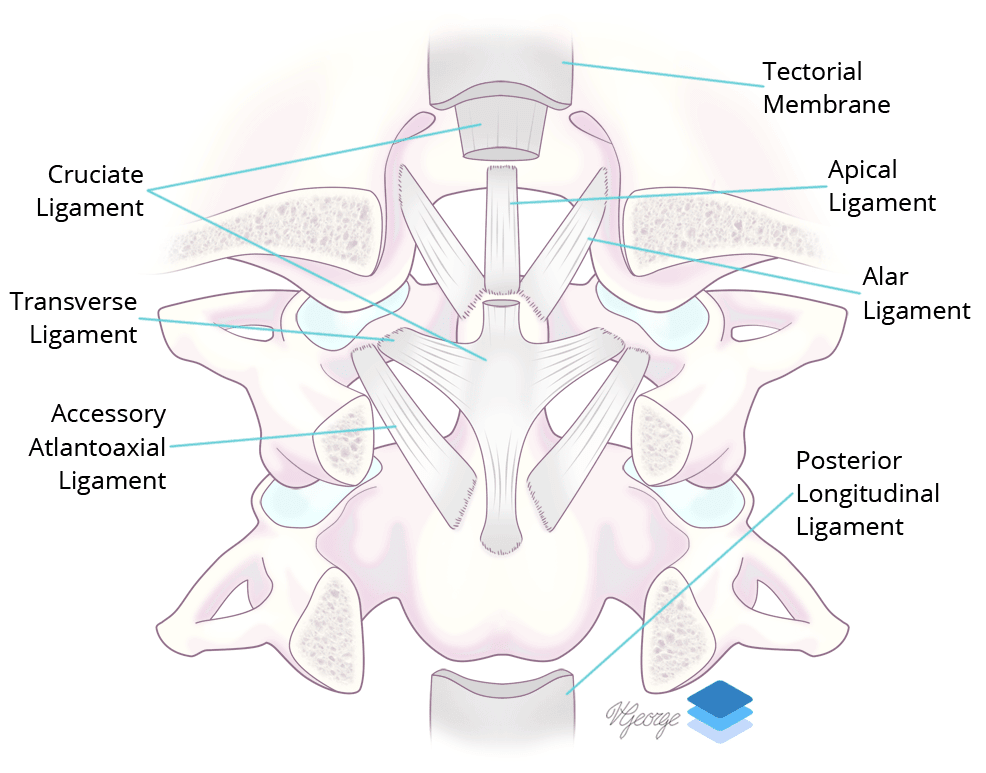
Coronal diagram of the major ligaments of the craniocervical junction.
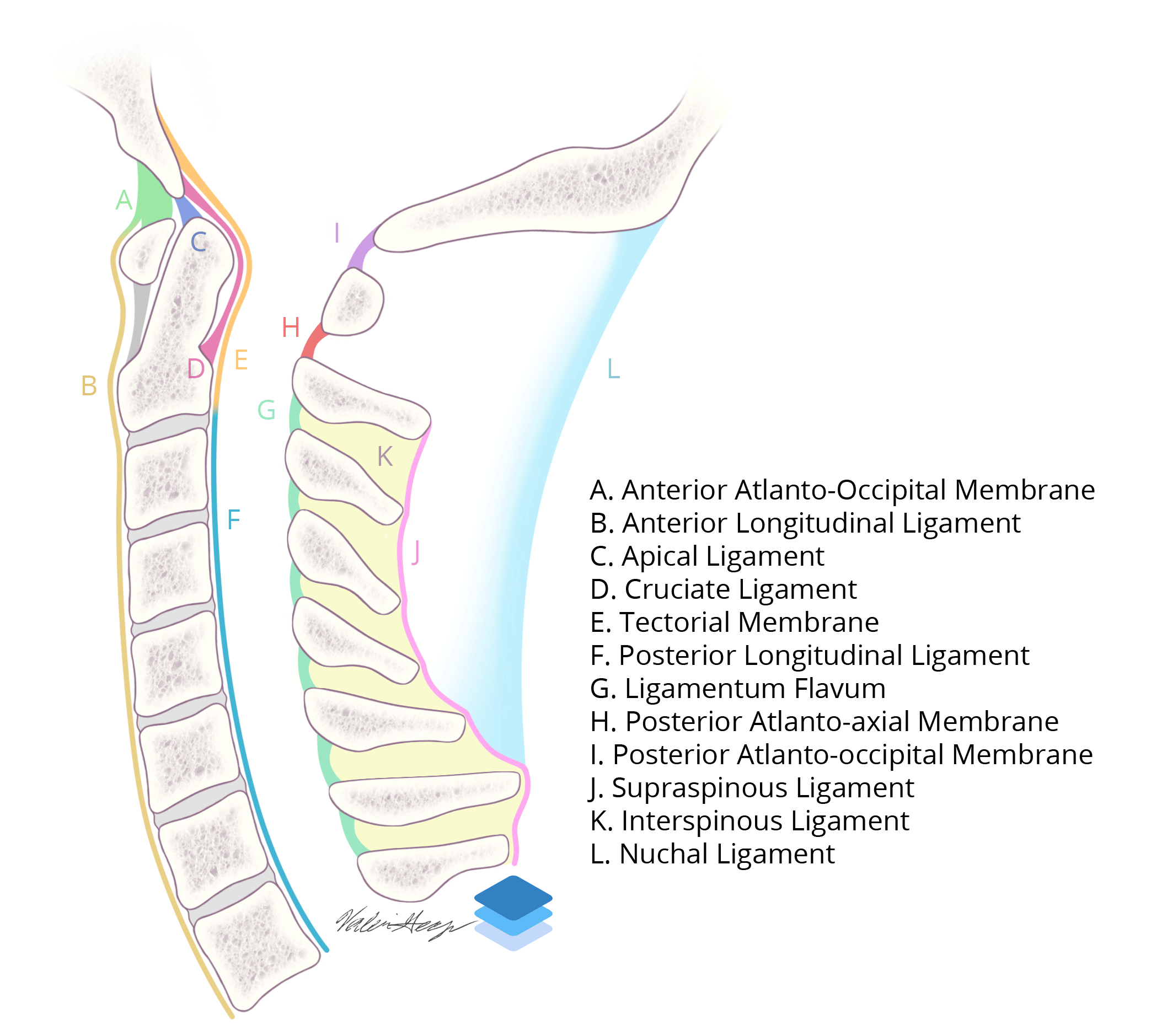
Sagittal diagram of the major ligaments of the cervical spine.