Use mouse wheel, arrow keys or left click (with scroll tool selected) to scroll
Drag with one finger (with the scroll tool selected) to scroll
DICOM HelpSource: Local (us-east1-c)


Findings
- Tubular, blind-ending structure in the right lower quadrant measuring 9 mm in diameter, which is noncompressible with mild wall thickening and mild mural hyperemia
- Superficial to this is a 2 x 2.5 cm ovoid hypoechoic structure which appears separate from the adjacent bowel and shows no internal vascularity
- Surrounding inflammatory changes in the right lower quadrant
Diagnosis
Appendicitis with periappendiceal abscess
Sample Report
Dilated appendix, measuring 9 mm in diameter, which is noncompressible with mild wall thickening and mild mural hyperemia, concerning for acute appendicitis.
Superficial to this is a 2 x 2.5 cm ovoid hypoechoic structure which appears separate from the adjacent bowel and shows no internal vascularity, concerning for a periappendiceal abscess.
Discussion
- Remember that ultrasound is a good initial test in children and thin young adults
- When assessing patients with appendicitis, make sure to look for complicating features such as periappendiceal abscess and evidence of perforation (including adjacent free air), as these may impact the nature and timing of intervention
- An abscess should not have internal blood flow, but commonly will have peripheral hyperemia
Annotated Images & Illustrations
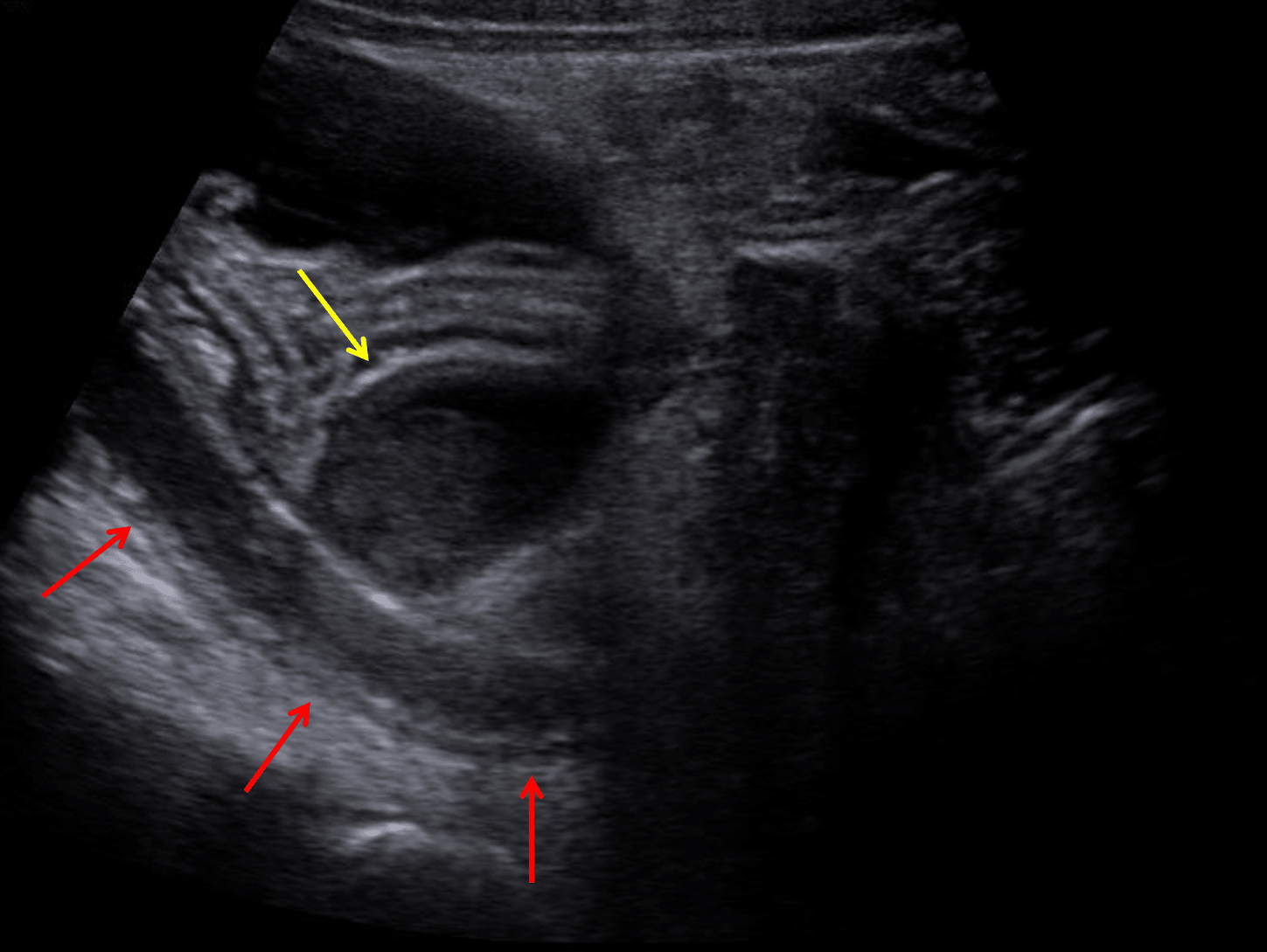
Dilated appendix with mild wall thickening (red arrows). Superficial to the appendix is a hypoechoic structure (yellow arrow), which did not show internal vascularity on color Doppler analysis and is concerning for an abscess.