Use mouse wheel, arrow keys or left click (with scroll tool selected) to scroll
Drag with one finger (with the scroll tool selected) to scroll
DICOM HelpSource: Local (us-east1-c)
Demographics:
11 years old, Female
Indication:
Knee injury
Findings
- Acute minimally depressed Salter IV fracture of the lateral tibial plateau
- Large joint effusion
Diagnosis
Tibial plateau fracture
Sample Report
Acute minimally depressed Salter IV fracture of the lateral tibial plateau. No physeal widening.
Large joint effusion.
No joint malalignment.
Discussion
- Tibial plateau fractures are most commonly characterized using the Schatzker classification, which classifies fractures by increasing severity of injury as well as increasing likelihood of poor outcome
- While it is not necessary to provide a Schatzker classification in your report, it is helpful to understand the classification scheme as it can help you create reports that are more readable for your referring surgeons. Note that the lateral plateau is injured with less severe trauma than the medial plateau
- Here is an overview of the Schatzker classification:
- I - Lateral plateau fracture with < 4 mm depression or displacement
- II - Lateral plateau fracture with depression or displacement > 4 mm
- III - Pure compression fracture of the lateral plateau
- IV - Medial plateau fracture with depression or split component
- V - Medial and lateral plateau fractures
- VI - Any of the above in addition to a transverse subcondylar fracture resulting in isolation of the metaphysis from the diaphysis
Annotated Images & Illustrations
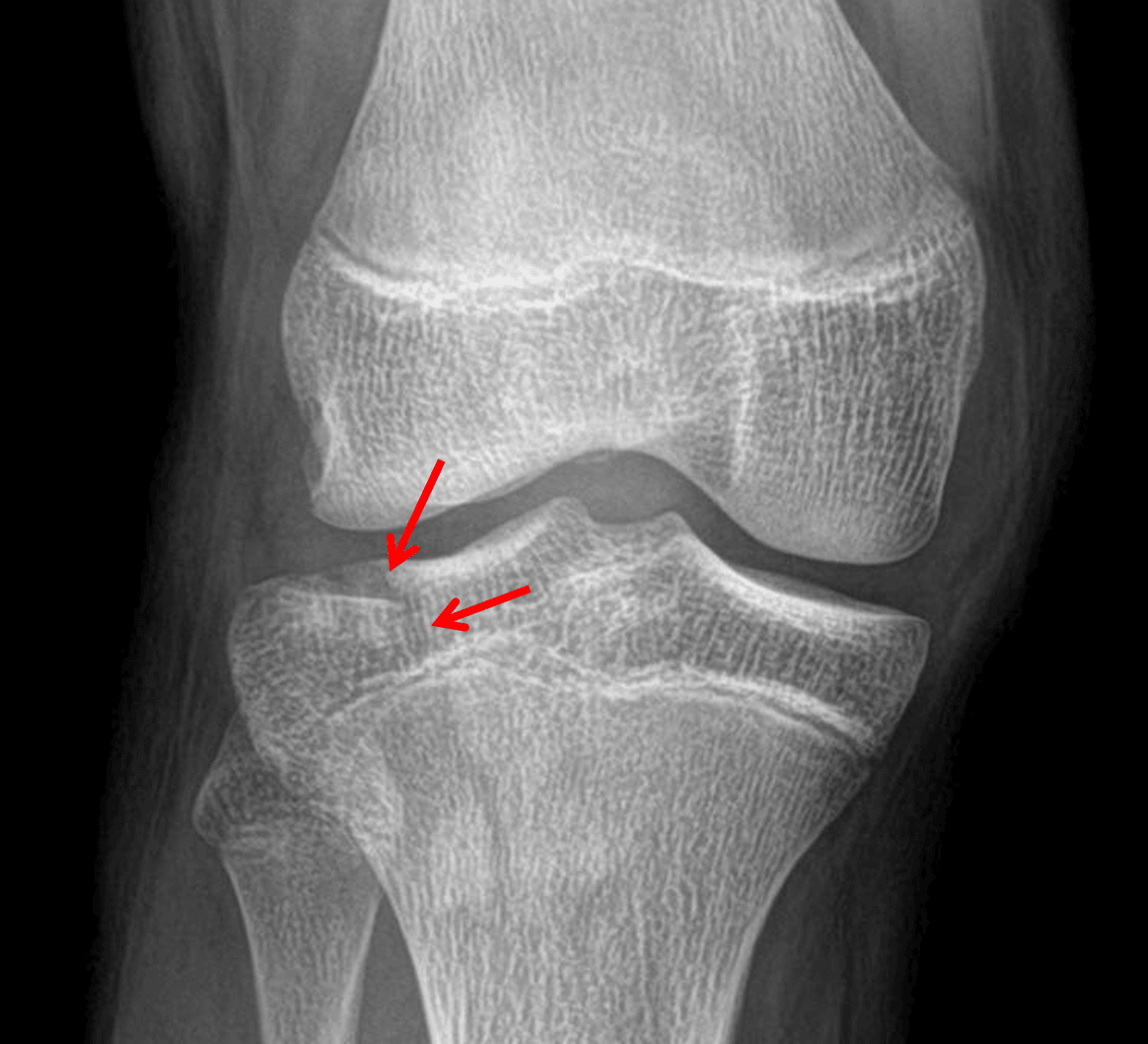
Red arrows: minimally depressed Saltar IV fracture of the lateral tibial plateau (Schatzker I).
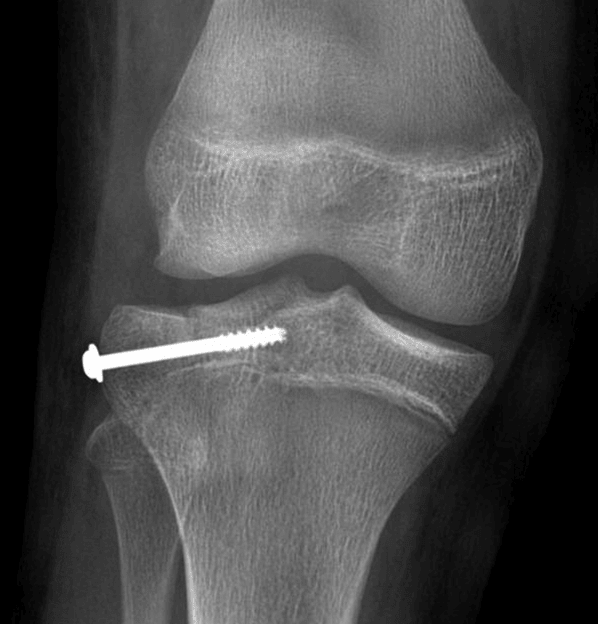
Postoperative radiograph in this patient.